




Table of contents
Editor's note:
For years, startup success meant one thing: grow fast, raise big. That is starting to change. Founders today face a new rule: profitability isn’t optional anymore. It’s how you survive.
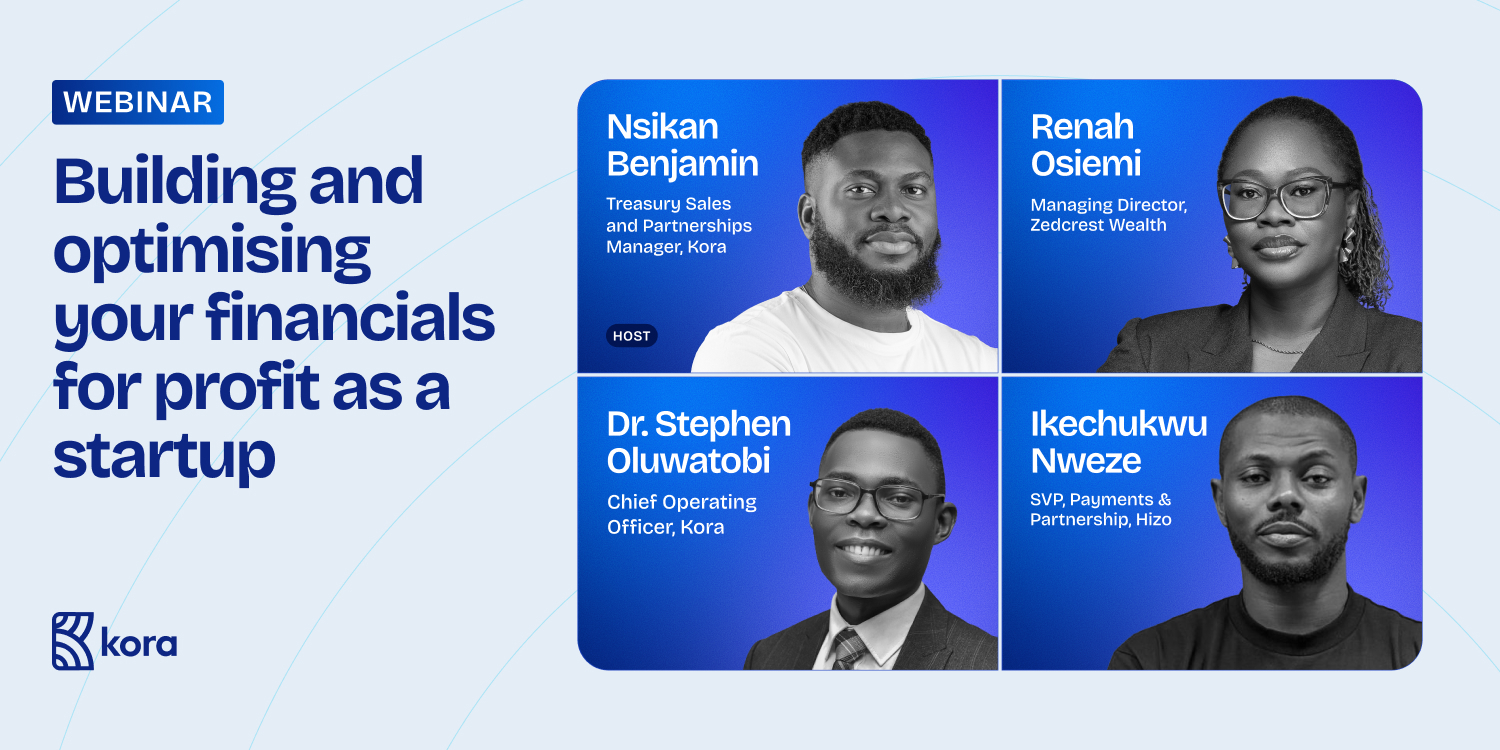
In a recent Kora webinar hosted by Nsikan Benjamin, Treasury Sales and Partnerships Manager at Kora, three industry experts broke down how early- to mid-stage startups can run lean, manage cash more effectively, and stay standing through hard times.
The panel featured:
- Dr. Stephen Oluwatobi, COO, Kora
- Renah Osiemi, Managing Director, Zedcrest Wealth
- Ikechukwu Nweze, SVP, Payments & Partnerships, Hizo
The great shift: From runway extension to real economics
For almost a decade, African tech had a gold rush. Big valuations and headline exits, like Paystack’s $200 million acquisition in 2020. But that abundance created bad habits.
Founders chased vanity metrics. They raised money not to scale something that worked, but to buy more time.
Dr. Stephen pointed out the fundamental economic error many startups made during this period:
"Simple economics tells us that the reward for entrepreneurship is profit... Where did they get this whole picture wrong that we started to pursue the wrong metric as to what growth really means? Now it’s like people are raising funds to extend the runway. Like, when will that journey end? You are basically gambling with the investors' money to extend the runway. Investors are not interested in that."
Investors have grown significantly smarter, moving away from the fear of missing out (FOMO) that defined the early 2020s. They are now auditing the core unit economics of businesses before cutting checks.
As Renah noted, being a technology business does not exempt a company from the basic rules of commerce:
"The fundamental is you're running a business anyway, and you're in business to make profit... Every additional customer should move you closer to profitability because at some point your cost needs to come down while your revenue is increasing."
The abundance trap: Mistaking spending for winning
When funding is easy, startups over-hire. They end up falling prey to inflated executive salaries and over-purchasing expensive software suites.
Ikechukwu highlighted how excess capital easily warps a founder's decision-making:
"When you now have excess money at your disposal, you end up making bad decisions. It's easier to burn money when you see money than to manage it... Revenue generation should be the primary goal of every startup."
A classic example of this waste is found in infrastructure and tooling. Ikechukwu shared an anecdote about a fellow founder who was spending between $8,000 and $9,000 a month on a web server purely because it was a "big name" recommendation.
By conducting thorough alternative research, Ikechukwu’s CTO helped them optimize and migrate, reducing their monthly bill to $2,000 and saving money that had been burning away.
Where the money really leaks
As a startup CFO, Ikechukwu admitted he is constantly pushing back on his marketing team. Marketers can easily defend a low Cost of Acquisition (CAC) on paper, but if those acquired users don't generate revenue, they become a liability.
Instead of burning cash to acquire cold traffic, the panel recommended:
- Focusing on Retention Over Acquisition: Reinvesting in the customers who already like and use your product is far cheaper than finding new ones.
- Organic Growth at Inception: Vent Africa scaled to its first 10,000 users purely through organic word-of-mouth and personal conviction, without a dedicated marketing budget.
- Deep Demographic Knowledge: Know your numbers down to the exact behaviors, locations, and asset preferences of your active transacting users.
Treat cash like an asset, not a parking spot
A major operational mistake startups make is letting idle capital sit in a standard checking account, earning zero return. In a high-inflation environment, that money is losing value every day.
Renah notes that treasury management isn't just for massive conglomerates; startups must also view cash as a strategic asset class:
"Cash is an asset. If you look at your balance sheet, you will see machinery... and you will see cash, but not many people think about cash in that way... Not only is inflation impacting that money that’s sitting at zero... There is a lost interest because you could have been doing something short-term."
Startups should categorize their cash into three pillars:
- Operating Cash: Kept highly liquid to manage immediate cycles like payroll and utility costs.
- Strategic Cash: Allocated for known upcoming expenses (e.g., software renewals or vendor payments due in 3 to 6 months).
- Reserve Cash: Set aside strictly for unexpected, rainy-day emergencies.
12 months of runway left? Do this
If your startup is facing a 12-month capital wall in a volatile environment, the speakers outlined a clear, actionable survival framework:
1. Stop the bleeding immediately
Dr. Stephen compared financial distress to a medical emergency:
"What does first aid teach us when bleeding takes place? Number one, stop the bleeding first."
Founders must ruthlessly eliminate corporate excesses, pause nonessential hiring, consider asset liquidations, and firmly separate personal lifestyle expenses from business capital.
2. Audit the unit economics. Cut what doesn’t work
Find out which channels, customers, or features actually make you money. If a feature or product line is bleeding cash without a clear path to profitability, retire it. Do not scale a broken model, as scaling an inefficient process only speeds up failure.
3. Build conditional scenario forecasts
When operating under high inflation and currency volatility, planning in isolation is fatal. Implement "conditional statement" planning.
Build distinct financial models for three scenarios: Best-Case, Mid-Case, and Worst-Case.
Continuously track external metrics, such as policy shifts, foreign-exchange exposure, and regulatory hurdles, to determine which script to execute.
Final words of advice
To wrap up the session, Ben asked each panelist for a single, defining piece of advice for startup leaders navigating today's economic climate:
- Renah: "Numbers. Possess it."
- Ikechukwu: "Growth is relative. Grow in the right direction."
- Dr. Stephen: "Know thyself, man... Make the right decision."
If you are interested in exploring other Kora webinar topics, visit our YouTube playlist for other recordings.



.png)


%201.png)
%201.png)

%201.svg)


%201.png)
%201%20(1).png)