

Table of contents
Editor's note:
Imagine asking an app to plan your wedding. Find the venue, check the weather, source some good red wine and pay for everything by Friday.
You give the instruction and get on with your day.
But between that instruction and the payment confirmation, an AI agent has made decisions for you. How do you know it made the right ones? And if something goes wrong, who takes responsibility?
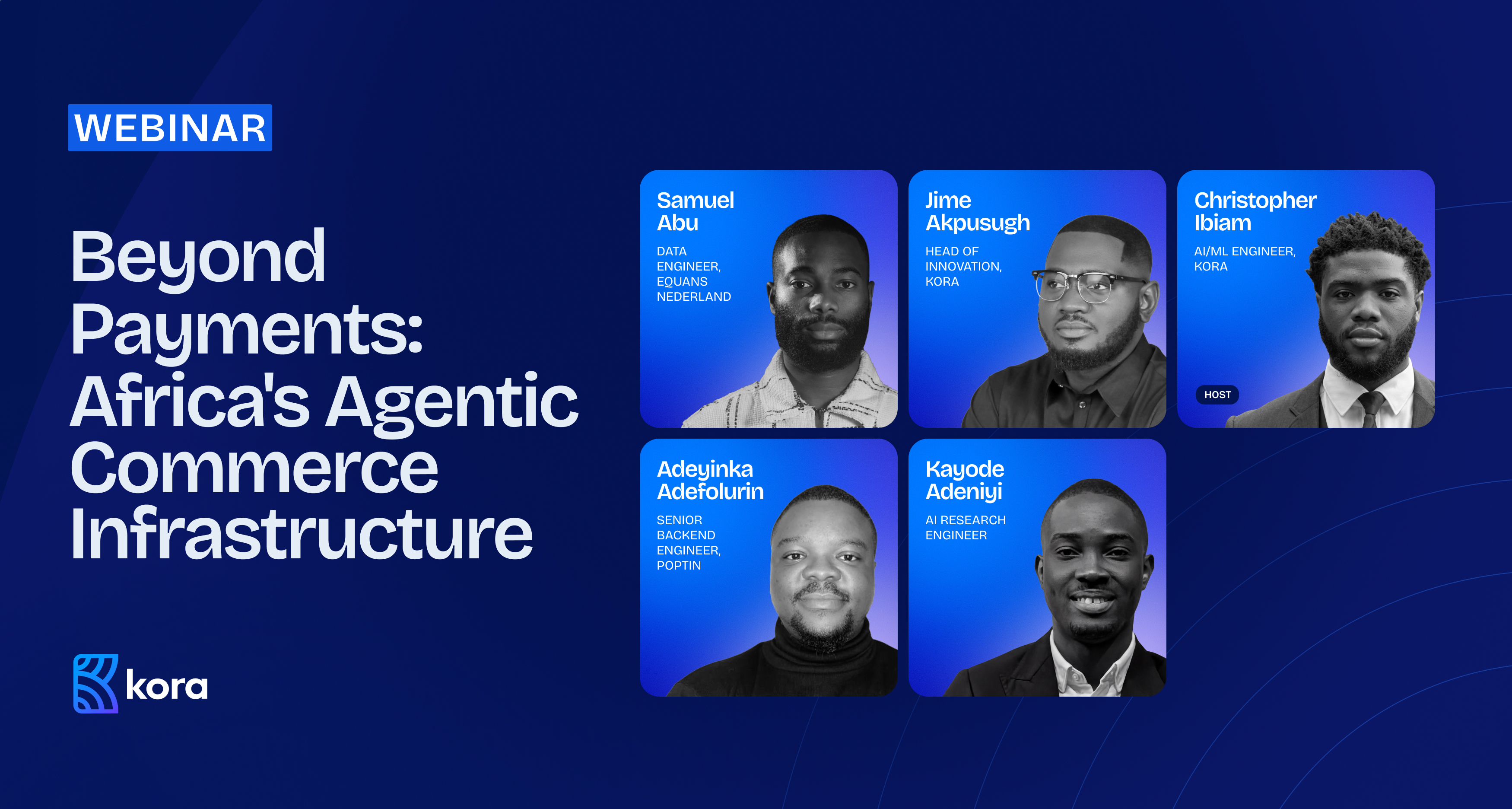
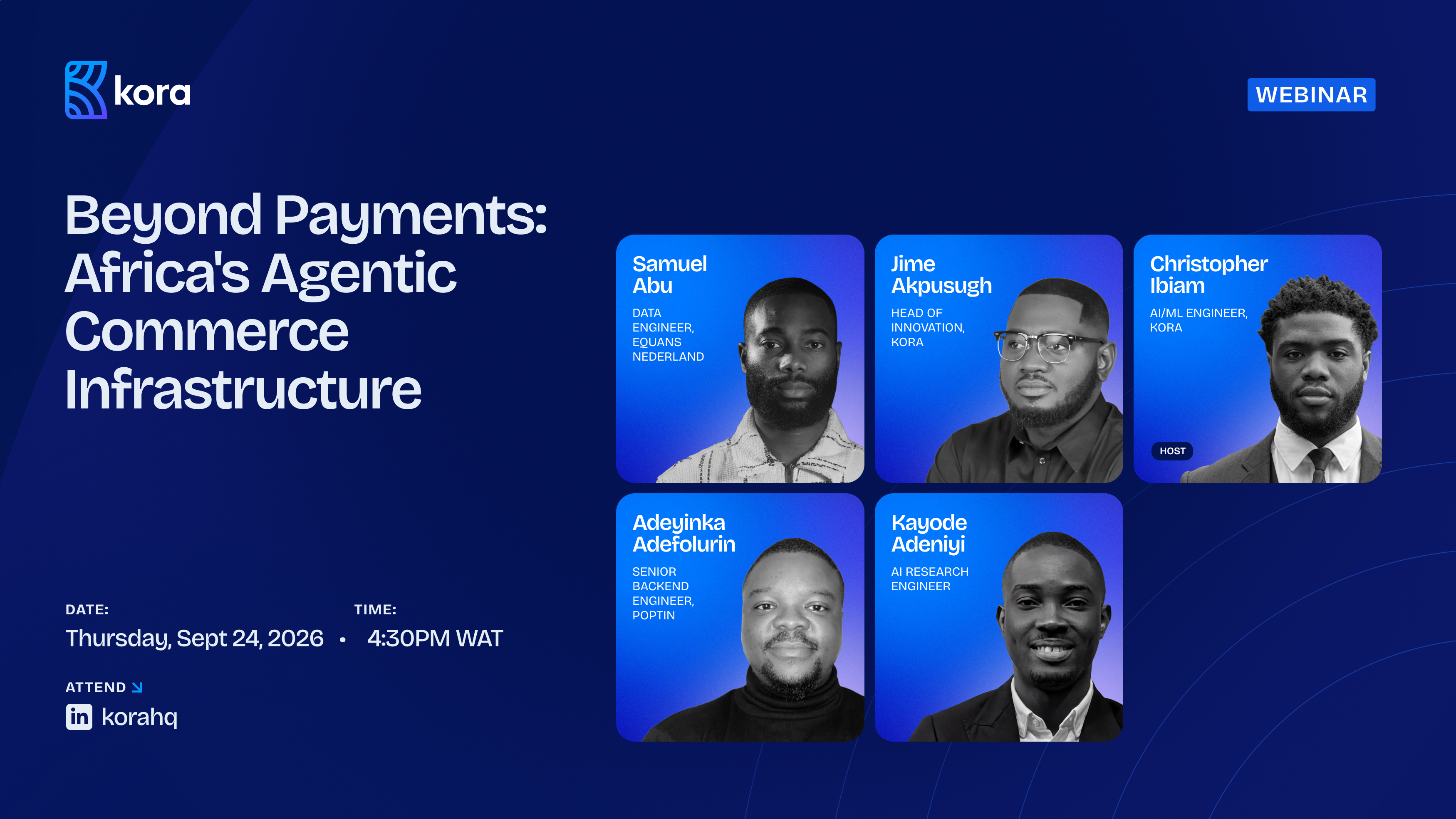
These were some of the questions explored at Kora’s recent webinar, Beyond Payments: Building Africa’s Agentic Commerce Infrastructure, where we brought in experts across AI research, engineering and payments to discuss what it will take to move from AI-assisted tasks to agent-led commerce.
The panel featured:
- Samuel Abu, Equans Nederland
- Jime Akpusugh, Head of Innovation, Kora
- Adeyinka Adefolurin, Senior Backend Engineer, Poptin
- Kayode Adeniyi, AI Research Engineer
- Christopher Ibiam, AI/ML Engineer, Kora
Who authorised the agent?
Financial services have established processes for verifying customers before they transact. AI agents introduce another challenge: how do you verify an agent acting on someone’s behalf and establish what it is authorised to do?
Kayode Adeniyi, an AI research engineer and PhD researcher, highlighted the gap in current approaches to agent identity.
“When it comes to agents, there’s really no definition of what KYA, know your agent, is right now.”
Without clear identity and authorisation mechanisms, businesses face difficult questions about trust, control and accountability, especially when agents operate across different markets.
When money moves, who takes responsibility?
An agent might misunderstand an instruction, select the wrong option or initiate a transaction the user never intended. And once a payment is complete, reversing it may not be straightforward.
Adeyinka Adefolurin, Senior Backend Engineer at Poptin, captured the challenge while discussing how to use AI to build and operate financial products.
“There is a very thin line with what you can undo.”
Samuel Abu, a data engineer at Equans Nederland, took the discussion further, arguing that responsibility rests with the people who build and deploy these systems, not the tools themselves.
“Don’t use AI for every part of a process. Deterministic code can handle predictable tasks, while AI can help interpret information and navigate situations that require reasoning. Manual fallbacks and clear escalation paths remain important when something goes wrong.”
The lesson for businesses is that automation doesn’t remove accountability. It makes clear authorisation, transaction records and appropriate controls even more important.
What needs to exist underneath?
A simple payment experience depends on reliable infrastructure behind it.
At Kora, we’re exploring conversational payments through Kovo, which enables people to make payments on WhatsApp. As Jime Akpusugh, Kora’s Head of Innovation, explained:
“What we want to do is to make payments as easy as sending a text message.”
But a conversational interface is only part of the picture. For AI agents to carry out transactions reliably, they need to connect with the right systems and tools, while payment processes maintain appropriate security, governance and oversight.
For African businesses operating across markets, that also means building on infrastructure that can support different payment needs and local contexts.
Samuel pointed to Africa’s history of adapting and leapfrogging technologies as an advantage:
“We as Africans have been able to leapfrog a lot of innovations by being innovative, being open-minded and being resourceful.”
Realising that opportunity will require more than adopting AI. It will take investment in infrastructure, reliable data and the controls needed to make these systems dependable.
The next phase of commerce needs more than AI
Agentic commerce could change how people discover products, make purchasing decisions and pay for services. But the technology alone won’t determine how successfully it develops.
Businesses need to establish what agents can do, who authorises their actions and who is accountable when things go wrong. They also need payment infrastructure that supports reliable transactions and allows people to intervene when necessary.
These questions matter as businesses explore agentic systems across African markets.
In Beyond Payments: Building Africa’s Agentic Commerce Infrastructure, our panel explored these challenges alongside the practical realities of building, testing and deploying AI agents, from audit trails and human oversight to whether one AI system can reliably reconcile another.
Watch the full webinar on YouTube to catch the full discussion and explore what it will take to make agentic commerce work in Africa.
Building for agentic commerce? Talk to our team about the payment infrastructure your business needs.