





Table of contents
Editor's note:
The wrong way to solve a fragmentation problem
There is a tempting but ultimately flawed approach to fixing Africa's cross-border payment problem: solve each piece of it separately.
Build a local payment integration for Nigeria. Then one for Kenya. Then Ghana. Add a stablecoin rail for the corridors where banking relationships are thin. Patch the FX access problem with a liquidity provider. Handle compliance market by market. Keep the fiat rails and the stablecoin rails as separate systems, managed separately, monitored separately, reconciled separately.
This approach works, to a point. Many businesses operating across African borders have built exactly this kind of infrastructure, and they move money more efficiently than those still routing everything through correspondent banks. But it has a ceiling. The more markets you add, the more complexity compounds. Every new integration is another system to maintain, another compliance layer to manage, another potential point of failure. The fragmentation problem doesn't get solved. It just gets reproduced at a higher level of sophistication.
The real infrastructure question for African payments in 2026 isn't whether to adopt modern rails. It's whether the rails can be unified.
What the problem actually looks like at scale
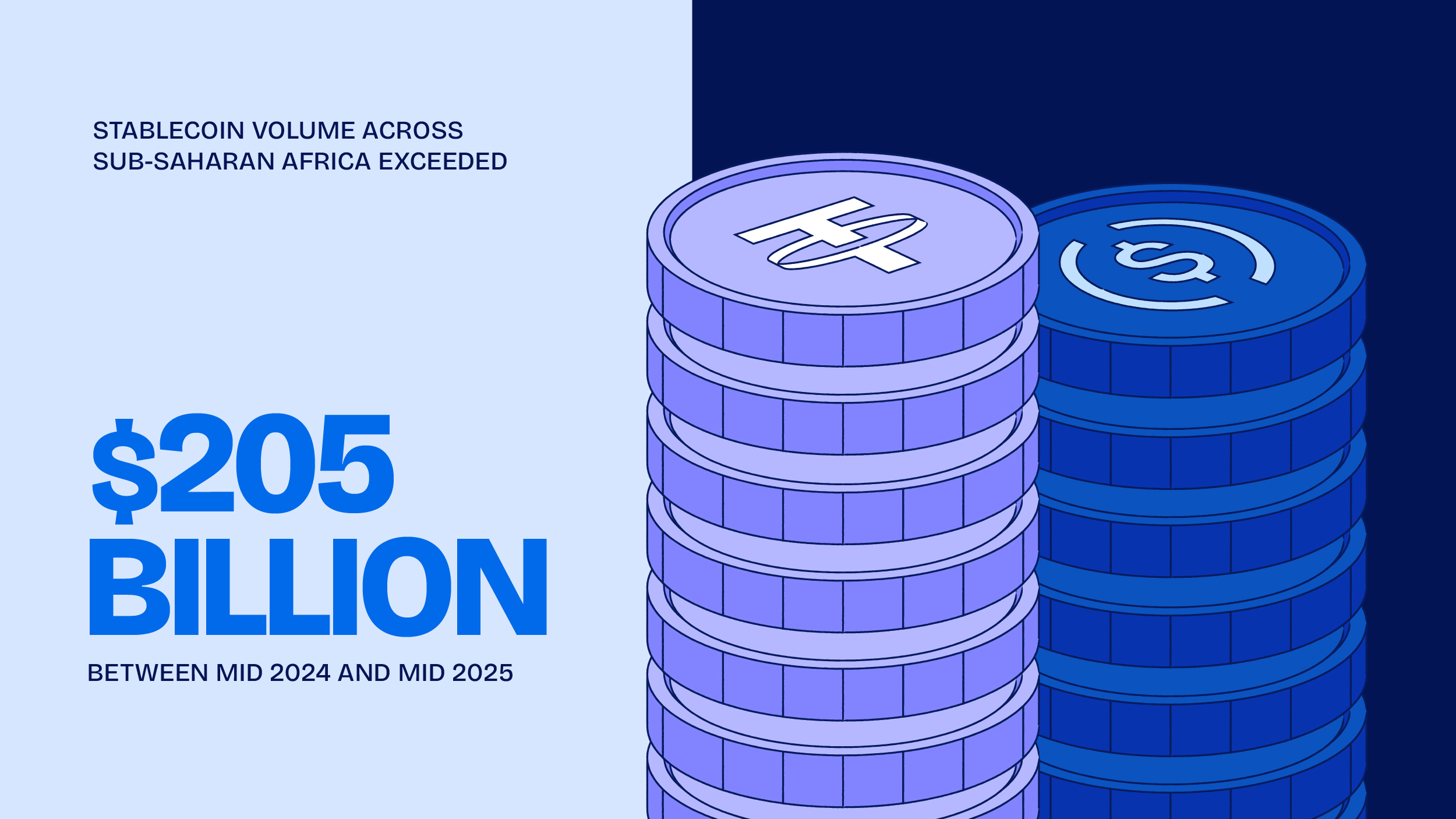
Africa has 54 countries, 42 currencies, and payment infrastructure that ranges from sophisticated real-time systems to markets still primarily served by mobile money and cash. There are now 36 live instant payment systems across 31 African countries, processing 64 billion transactions worth nearly $2 trillion in 2024. PAPSS is connecting 28 countries and more than 190 commercial banks, with early data suggesting cost savings of up to 27% for end users. On-chain value across Sub-Saharan Africa exceeded $205 billion between mid-2024 and mid-2025, with stablecoins accounting for 43% of that activity.
Each of these developments is real progress. But they are happening on separate tracks. PAPSS handles local-currency bank settlement. Stablecoin rails handle dollar-denominated flows. Mobile money networks operate within their own ecosystems. Instant payment systems are live in some markets and absent in others. A business trying to trade across multiple African markets doesn't get to choose one of these systems and call it done. They have to navigate all of them simultaneously, which means maintaining connections to multiple rails, managing liquidity across different systems, and building compliance processes that work across each one.
Modern businesses are being forced to operate on top of fragmented systems that were never designed for real-time, global, programmable payments. The infrastructure wasn't built that way on purpose. It evolved that way, one country at a time, one banking relationship at a time, one regulatory framework at a time. But the result is the same: a payment landscape where the complexity of doing business across borders is carried largely by the businesses themselves, not abstracted away by infrastructure designed to handle it.
What unified infrastructure actually means
The concept of a unified rail isn't about picking one technology and declaring it the winner. Fiat rails, stablecoin rails, mobile money networks, and instant payment systems each solve different things well. Local-currency settlement through PAPSS is the right tool for bank-to-bank settlement between markets with direct currency relationships. Stablecoin rails are the right tool for corridors where banking relationships are thin or where speed and 24/7 availability matter more than local currency denomination. Mobile money is often the right last-mile delivery mechanism in markets where bank account penetration is low.
The insight is that these shouldn't be separate systems requiring separate integrations. They should be layers within a single infrastructure, with routing logic that determines which rail is optimal for any given transaction automatically, rather than forcing businesses to make that determination manually or build separate connections to each system.
In practice, unified infrastructure means a business connects once and reaches multiple markets through multiple rails, with a single API handling the routing, compliance, and settlement logic underneath. Liquidity is managed centrally rather than fragmented across pre-funded accounts in each corridor. FX conversion happens at the point of payout rather than being baked into every step of the transaction chain. Compliance, KYC, and AML checks run consistently across all rails rather than being rebuilt separately for each one.
This is not a theoretical architecture. It is already the direction the most sophisticated payment infrastructure companies in the world are building toward. Stablecoins are shifting from being a parallel financial system to becoming a practical funding rail that enhances existing payment infrastructure, with stablecoin liquidity in and fiat out to the user's preferred local method. The businesses that connect once and reach multiple rails are already outcompeting those maintaining separate integrations for each corridor.
Why Africa specifically needs this
The case for unified payment infrastructure is compelling globally. In Africa, it is urgent.
The fragmentation problem is more severe here than anywhere else. Fifty-four regulatory environments. Forty-two currencies. Banking infrastructure that varies more between neighboring countries than it does between countries on other continents. The compliance overhead of navigating each market separately is prohibitive for any business that isn't large enough to dedicate significant resources to payment operations. And the businesses that most need efficient cross-border payment infrastructure, the SMEs that represent 80% of African employment and more than half of GDP, are precisely the ones least equipped to absorb that complexity.
At the same time, the opportunity is larger here than anywhere else. Intra-African trade is growing. AfCFTA is creating new commercial relationships across borders that have historically barely traded with each other. The stablecoin and instant payment infrastructure being built right now is establishing the rails that will underpin that trade for the next decade. The businesses and infrastructure providers that are positioned at the center of that buildout now, while the architecture is still being established, are in a fundamentally different position from those that try to connect to it later.
The correspondent banking network that historically handled cross-border payments in Africa is thinning. The vacuum it's leaving isn't being filled by one replacement. It's being filled by a layer of infrastructure that combines fiat rails, stablecoin settlement, and local payment networks into something more direct, more efficient, and more designed for how African trade actually moves.
The one rail thesis
Across this series, we've looked at the hidden costs baked into how money moves across African borders, the structural decay of correspondent banking, the stablecoin ecosystem building on top of it, and the liquidity mechanics that determine whether any of this actually reaches businesses and merchants. The through-line across all of it is the same: the old system was built around intermediaries, and the new one is being built around directness.
One rail is what that directness looks like in practice. Not one technology. Not one network. One connection that gives a business access to the full range of payment infrastructure available across African markets, fiat and stablecoin, bank and mobile money, local currency and dollar-denominated, routed automatically to whatever is optimal for each transaction.
There is also a demand-side dimension to this that doesn't get enough attention. Payment infrastructure isn't just a back-office question. It determines which customers a business can actually serve. Younger customers, the ones who are increasingly the buyers, employees, and business owners shaping commercial activity across Africa and globally, are already paying and expecting to be paid differently. 71% of Gen Z and 60% of millennials say they are willing to use stablecoins for everyday purchases. 75% of Gen Z stablecoin users prefer to receive their salaries in stablecoins. Stablecoin settlements accounted for a growing share of merchant payment activity in 2025, up significantly from the year before. A business or payment provider that can't accept or disburse value through these rails isn't just behind on infrastructure. It is leaving a growing share of commercial activity on the table.
In the US alone, an estimated $100 trillion in wealth is projected to pass to younger generations over the coming decades, mostly to millennials. It's a signal of where financial behavior is heading globally, including in markets like Africa, where stablecoin payment rails are already familiar, already trusted, and already part of how younger generations operate financially. As that transition plays out, and as more merchants and businesses accept stablecoins, something will happen that has happened before with every major payment infrastructure shift: the technology will become invisible. Nobody today thinks about which network processes their card payment. They just pay. The conversation about stablecoins as a trend or an emerging category will eventually give way to stablecoins as simply the way payments work, embedded in everyday financial behavior without friction or deliberation. The rail will be irrelevant. The outcome, fast, direct, low-cost settlement, will be all that matters.
The African payment infrastructure problem has never really been about any single corridor or currency pair being too expensive or too slow. It's been about a system that requires businesses to carry the complexity of operating across 54 different markets entirely on their own. Unified infrastructure solves that problem at the source, by making the complexity the infrastructure's job rather than the business's.
At Kora, this is the problem we're building for. Payment infrastructure that connects African businesses to global commerce through a single rail, carrying both fiat and stablecoin flows, across the corridors that matter, without the fragmentation that has made every new market a new integration project. The businesses that operate on infrastructure built this way don't just move money more efficiently. They trade at a different speed, with a different reach, than those still carrying the complexity themselves.


.png)


%201.png)
%201.png)

%201.svg)


%201.png)
%201%20(1).png)